Labels

Bible Problems (19) Bible (17) Jesus (11) Jesus Christ (10) Sex (9) Marriage (7) Prophecy (7) Grace (6) Homosexuality (6) Creation (5) God (5) Moses (5) Paul (5) Salvation (5) Ceremonial Law (4) Creation Evolution (4) Evolution (4) Heterosexuality (4) Moral Law (4) Morality (4) Abraham (3) Angels (3) CS Lewis (3) Calvinism (3) Children (3) Church (3) Free Will (3) Love (3) Orientation (3) Prayer (3) Predestination (3) Premarital Sex (3) Temple (3) Temple Destruction (3) Transgender (3) Transgenderism (3) Works (3) Abortion (2) Abstinence (2) Angel (2) Bible Prophecy (2) Catholic (2) Character of God (2) Christianity (2) Church History (2) Determinism (2) Ezekiel 28:12-17 (2) Faith (2) Faith & Science (2) Fetus (2) Flood (2) Forgiveness (2) Genesis 6 (2) Gentile (2) Homosexual Sin (2) Israel (2) Jehovah's Witnesses (2) Job (2) Jonah (2) Mosaic Law (2) Myth (2) Old Testament (2) Peter (2) Romans 8:28-39 (2) Salvation by Grace (2) Satan (2) Saul (2) Science (2) Sexual Orientation (2) Sexuality (2) Sin (2) Theistic Evolution (2) Translation (2) Trinity (2) Trust (2) 1 Cor 6:9 (1) 1 Cor 7:36 (1) 1 Cor 7:39 (1) 1 Cor 9:10-11 (1) 1 John 1:8 (1) 1 John 4:16 (1) 1 Sam 19:9 (1) 1 Tim 2:11-15 (1) 1 Tim 5:17-18 (1) 10 Commandments (1) 2 Cor: 6:14 (1) 2 Peter 3:9 (1) 2nd Coming (1) 2nd Temple (1) 3rd Temple (1) 4 Beasts (1) 4th Commandment (1) 501c3 (1) 5th Commandment (1) 9/11 (1) A.I. (1) AI (1) Abram (1) Acts 17 (1) Adam (1) Affluence (1) Age of Accountability (1) Age of Disciples (1) Aliens (1) Allah (1) America (1) American Christians (1) American Slave Trade (1) Analogy (1) Animals (1) Anne Rice (1) Antediluvian (1) Apostasy (1) Arrogant (1) Artificial Intelligence (1) Assyria (1) Atonement (1) Augustine (1) Baby (1) Beatitudes (1) Beginning (1) Behemoth (1) Believer (1) Big Bang (1) BioLogos (1) Birth Control (1) Body (1) Book of Mormon (1) Boundaries (1) Bridegroom Of Blood (1) Calvin (1) Canaanite Conquest (1) Canaanite Woman (1) Carl Sagan (1) Celibacy (1) Chalcedon (1) Child Sacrifice (1) Children of Israel (1) Choice (1) Christ The Lord Out of Egypt (1) Christian Dating nonChristian (1) Christianity Borrowed from Mystery Cults (1) Christianity is a Crutch (1) Christmas (1) Church Fathers (1) Church Problems (1) Church and Slavery (1) Church and State (1) Circumcision (1) Clean and Unclean foods (1) Cloud over Tabernacle (1) Co-dependence (1) Cohabitation (1) Col 1:15 (1) Col 2:8 (1) Computers (1) Conviction (1) Cosmological Argument (1) Count the Cost (1) Creation Mandate (1) Creed (1) Crocodile (1) Cross dressing (1) Crucifixion (1) Crutch (1) Cults (1) Cynthia Nixon (1) Damnation (1) Daniel (1) Daniel 7:15-18 (1) Darwin (1) Dating (1) Dead Sea (1) Death (1) Deception (1) Defile (1) Demonic Possession (1) Demons (1) Deut 22:28-29 (1) Deut 22:5 (1) Deut 7:3-4 (1) Deuteronomy 28:63 (1) Devil (1) Dietary Laws (1) Dinosaur (1) Dinosaurs and the Bible (1) Disciple (1) Disciples (1) Discipleship (1) Disobedience (1) Divine (1) Divinity (1) Divinity of Christ (1) Divorce (1) Doctrine (1) Dog (1) Doxology (1) Dress (1) Egypt (1) Elisha (1) Emergent (1) Emerging (1) End Times Timetable (1) Eph 3:9-10 (1) Eternity (1) Eve (1) Evidence for God (1) Evil Spirit (1) Existence of God (1) Existence of Jesus (1) Exodus 21:15 (1) Exodus 4:24-26 (1) Exorcism (1) Ezekiel 1 (1) Faith vs Works (1) Fall (1) Fallen Angels (1) Food laws (1) Freedom Tower (1) Gabriel (1) Galatians 6:1-5 (1) Galileo (1) Gay (1) Gen 1:12 (1) Gender Confusion (1) Genesis (1) Genesis 1 (1) Genesis 17:5 (1) Genesis 32:28 (1) Genetic Engineering (1) Giving (1) Glenn Beck (1) Global Warming (1) Glory (1) Gnostic (1) God Tempts (1) God of Love God of Wrath (1) God's Love (1) God's laws (1) Gomorah (1) Greed (1) Guilt (1) Harbinger (1) Hate Parents (1) Health and Wealth (1) Heaven (1) Heb 13:4-5 (1) Heb 1:14 (1) Hell (1) Hippo (1) Hippopotamus (1) Holy Place (1) Holy Spirit (1) Holy War (1) Holy of Holies (1) Horus (1) Hosea 4:3 (1) House in Order (1) Hugh Ross (1) Humanity of Jesus (1) IRS (1) Idolatry (1) Idols (1) Images (1) Images of God (1) Immaculate Conception (1) Intelligent Design (1) Iraq (1) Is Allah the same as the Christian God (1) Is God A Moral Monster? (1) Isaac (1) Isaiah (1) Isaiah 11:1 (1) Isaiah 14:12-15 (1) Isaiah 19:21-25 (1) Isaiah 7:16 (1) Isaiah 9:9-10 (1) Islam (1) Jacob (1) James 2:24 (1) Jephthah (1) Jephthah's Daughter (1) Jesus Disciples (1) Jesus Divinity (1) Jesus Prophecy (1) Jesus' Siblings (1) Jew (1) Job 40:17 (1) Job 41-42 (1) Job 41:22:34 (1) John 19:14 (1) John 2:2 (1) John 3:19 (1) John 6:66 (1) John Lennox (1) John Sanford (1) Jonathan Cahn (1) Joseph (1) Joseph Smith (1) Josephus (1) Judaism (1) Judas (1) Judges (1) Judges 11:29-40 (1) Judgment (1) KJV (1) King James (1) LaHaye (1) Last Supper (1) Law of Love (1) Left Behind (1) Leviathan (1) Lincoln (1) Literal (1) Long Life (1) Long Life Spans (1) Lord's Prayer (1) Love for Enemies (1) Love our Enemies (1) Luke 10:7 (1) Luke 12:21 (1) Luke 14:25-33 (1) Luke 1:10-11 (1) Luke 7:47 (1) Luke 8:19-20 (1) Manuscripts (1) Mark 15:25 (1) Mark 2:17 (1) Mark 3:31-32 (1) Mark 7:24 (1) Marx (1) Mary (1) Mary mother of Jesus (1) Matt 12:46-47 (1) Matt 13:22 (1) Matt 18:3 (1) Matt 22:30 (1) Matt 6:9-13 (1) Matthew 15:21-28 (1) Matthew 16:28 (1) Matthew 19:17 (1) Mind (1) Mind and Cosmos (1) Mithras (1) Modern State of Israel (1) Money (1) Moral Issues (1) Moral Relativity (1) Mormon (1) Mormonism (1) Muslim (1) Mythology (1) NT Wright (1) Names Changed By God (1) Names for God (1) Natural Disaster (1) Nature (1) Nature religion (1) Nephilim (1) New Name (1) New Testament (1) New World Translation (1) Non-Profit Status (1) Nostradamus (1) Numbers 9:15-23 (1) Obedience (1) Obey the Gov't (1) Offering (1) Old and New Testament picture of God (1) Once saved always saved (1) Orthodoxy (1) Pagan (1) Pagan holiday (1) Parents (1) Passion Movie (1) Passover (1) Pastors (1) Paul Copan (1) Perpetual Virginity (1) Peter Singer (1) Philemon (1) Pluralism (1) Polygamy (1) Pompeii (1) Predictions (1) Pro-choice (1) Pro-life (1) Progressive Creationism (1) Promised Longevity (1) Prophet (1) Protestant (1) Ps 8:3-5 (1) Psalm 22:16 (1) Purification (1) Rape (1) Rebellious (1) Repentance (1) Respect (1) Rest (1) Resurrection (1) Return of Christ (1) Revelation (1) Revelation 17:9-11 (1) Richard Hess (1) Risen Movie (1) Ritual (1) Robin Hood (1) Roe V Wade (1) Roman Catholic (1) Romans (1) Romans 12:1-2 (1) Romans 9 (1) Romans 9:14-15 (1) Sabbath (1) Sabbath Keeping (1) Sacrifices (1) Salvation by Works (1) Sampson (1) Satan's Fall (1) Satan's origin (1) Saving Faith (1) Sentience (1) Serpent (1) Servanthood (1) Sexual Preference (1) Simon (1) Sin Lists (1) Single (1) Sinless (1) Skeptic (1) Slavery (1) Socialism (1) Sodom (1) Son of God movie (1) Sons of God (1) Soul (1) Soylent Green (1) Spiritual Warfare (1) Suicide (1) Sumerian Kings (1) Symbols (1) Syria (1) TULIP (1) Tabernacle (1) Tacitus (1) Temptation (1) The unforgivable sin (1) Thomas Nagel (1) Transfiguration (1) True Christianity (1) Truth (1) Turing Machine (1) Twin Towers (1) Unequally Yoked (1) Unseen Realm (1) Violence in the Bible (1) Was Christianity a Myth (1) Weak minded (1) Wealth (1) When Helping Hurts (1) Wilberforce (1) William Lane Craig (1) YEC (1) Young Earth Creationism (1) Youth (1) Zechariah (1) burden bearing (1) burdens (1) elders (1) faith versus science (1) food (1) free from the Law (1) ignorant (1) leadership (1) morals (1) oaths (1) occult (1) rash vows (1) vows (1) women (1) women in leadership (1) women in ministry (1)
Showing posts with label Creation Evolution. Show all posts

Thursday, May 17, 2018

Should I Read Genesis as Fact or Poem?


QUESTION:  With all the evidence for the Big Bang, the moon coming from the earth or some other planet, humans evolving from an early ape-like ancestors, etc, how should I view Genesis?  The bible says nothing about God making dinosaurs or other planets, it seems to portray Earth as the center of the universe. It says that humans all came from two humans that had no earthly parents or ancestors, and a lot of other things.  Noah’s Ark was also nearly an impossible event with a lot of “plot holes,” as well as the tower of babel and several other events.  It seems one can't see them as fact, so should I look at these as merely stories or epic poems, like Jesus’s metaphorical stories and hyperbole?

RESPONSE:  You're choosing between fact or poem, but this leaves out a third way to see a story: myth.  Myth can be both poetical and factual without it also being in all places literally true.  It's important to define "myth" properly, because in our vernacular, myth often means “fictitious tale” and even more strongly we sometimes mean, “a lie”.  Like when we say, the “myth of a flat earth” or the “myth of Bigfoot”.  We mean, something opposite of the truth. 

But in literature there are many cases where myth is actually pointing at truth.  In two ways:  First, myth could be like the parables of Jesus, which you mentioned.  These are non-historical stories which nevertheless reveal a “spiritual” truth.   These stories didn’t happen, they were non-historical events made up out of Jesus head, but they convey divine truths.  

If you look at Genesis this way, you are at least showing some respect for the text, but you wind up vacating it of any historical veracity at all, and (as I'll explain below) that runs into problems for the veracity of the global Christian story.

So I think you should open up to another kind of myth genre for some parts of Genesis.  Namely, 'a true event that really happened, or refers to people who really existed, but the facts are conveyed using non-literal settings or incomplete data or using exaggerated language'.   If taken literally such stories would be inaccurate, but if taken in its proper context or genre (like exaggeration, or metaphor, or poetry, or dream) is conveying actual facts.

Speaking of lenses, it is not a test of Christian orthodoxy to look at Genesis through the lens of strict, 6 day, young earth creationism.  And I concede this, not because of the pressures of modern scientific discoveries.  The Church Fathers Augustine and Origen both thought that the days of Genesis were non-literal.  IE: not 24 hour solar days.  Writing in the 300’s they were obviously not influenced by modern geology or astronomy!

Augustine’s view was affected by philosophy and by the text.  He believed God to be timeless, so, he asked, why are there any days of creation at all?  These must reflect some kind of creative potencies inside of God himself, he thought, and not convey actual time passing.  Also Origen noted the text itself suggested that the “days” were non-literal.  He noticed, as all Bible students do in a surface reading of Genesis one, that the sun shows up on day 4.  How can one have 3 solar days before there’s even a sun? 

Other reasons the text suggests a non-literal understanding of Genesis 1:  the text says, “let the earth bring forth fruit/seeds” and the original audience would understand that plants take many days and months, sometimes years to produce their seeds and fruit.  This can’t be a literal day, even to the first readers.

Also “let the land bring forth…” sounds strangely like some kind of natural development is happening without God directly bringing things into existence out of nothing.  Ironically, if you take this very literally, it looks like vegetation somehow comes out of the land by an ability God infused into the land.  There are serious Christians who are theistic evolutionists who take note of this.  There are biblical literalists who here might say, but everyone knows that God is bringing forth these creations instantly.  Do we?  That's not what it LITERALLY says.  So even a young earth perspective does not view the text literally at every turn.

Once Genesis is unhinged from strict literalism for good reasons that Christians have cited for literally millennia, we’re free to follow the evidence wherever it leads.  If we find out the universe is old, can Genesis accommodate that?  Yes.  Could God have imbued nature with some creative properties?  Genesis can accommodate that too.  Ironically, I think there are more serious scientific problems with thinking that inert matter can do all the work of making the complex bio-diversity of planet earth, than there are theological problems because of Genesis 1.

God could have used the natural processes and laws which he built into creation at the outset (the fine tuning of which powerfully suggests design), or he could have interfered in creative acts by infusing new information into the system over time.  These creative epochs, could be what’s meant by the creation days where each one is set apart with:  “Then God said…”

Here, I would just caution against thinking that because Genesis 1 may be non-literal it must therefore be a “mere story”.  Even if non-literal, Christians believe Genesis is communicating enormous truths – and not merely theological truths:

For example, Big Bang cosmology is a massive confirmation of Genesis cosmology.  Think about it:  for centuries ancient pagans believed in an eternal universe, that the primal titans were forces of nature that preexisted everything else including the gods and men.  In other words, matter came first, mind came second.  Modern atheistic thinking repeated this model with steady state theories of eternal universes without beginning or end.  But when the universe was found to be expanding, suddenly Moses, a Bronze Age nomad turns out to be the only ancient who got his cosmology right:  “in the beginning”.

In fact, here are five truths that come out of the creation “myth” of Genesis One if you look beyond the “literal” level.  Each of these revelations disagreed with pagan mythology and modern cosmology until Einstein, and yet now are all considered unchallengeable facts:
  1. The universe has not always existed but began at a finite point in time. 
  2. The universe began in an explosion of light
  3. The universe evolved from chaos, emptiness and formlessness to order, filling, and form. 
  4. The unfolding of creation did not happen all at once, but gradually over time
  5. Youngest of all creatures on earth is mankind who is made, not out of nothing, but out of preexisting material, all of which can be found in the earth itself (dust).

This is uncanny!  Mythical?  Sure.  Untrue?  Nope.

Then we get to Adam and Eve.  Here again, the fact that they are made “from the dust” can be an open door to harmonize the evolutionary picture with Genesis if we think that’s where the evidence points.  How exactly did God “form” them from the dust?  Genesis doesn’t say, so we’re free to investigate that problem and suggest theories.  Christians are deeply divided as to the “how”.  Some will insist we need two persons made without preexisting forms.  Some suggest Adam and Eve (literally "man" and "mother") could be titles for a group of individuals set apart somehow from the rest of the animal kingdom.  If we turn to science, the idea of a two person “bottle neck” in human history is debated based on modern genetics, but science hasn't ruled it out either..

But why even bother to try to prove Adam and Eve might be historically plausible?  What’s really at stake in the Adam and Eve story?  Well, there is at least a couple of very important things theologically at stake that matters for the whole Christian story, without which Jesus' work on the cross just doesn’t make sense.  So what are those indispensable parts of this story to Christianity and therefore to you if you become a Christian?

Simply this: Man, as God made him, was completely good and completely happy, but he disobeyed God and became what we now see.  A creature in need of redemption, forgiveness, and restoration back to his creation design.  That is a bare minimum of what we must believe to be true about Genesis or else Jesus is out of a job.

Now, many people think even that simple premise is proved false by modern science.  They take Darwinism to imply that a “Fall” is the opposite of what science allows.  That rather than fall from a primeval state of virtue and happiness, people have slowly risen from brutality and savagery.

At this point, I would simply point you to CS Lewis' Problem of Pain where he offers up a very convincing harmony between Darwin’s account of the rise of mankind, and the Bible’s account of the fall of mankind.  Significantly, what he rejects about Darwin is Darwin's "unguided" philosophical underlay.  Common ancestry, change over time, preexisting hominid forms?  To Lewis, none of those things refuted the fact of creation, or the discontinuity of people with the rest of the animal kingdom, nor an actual, historical fall from harmony into sin.

I'll include a link where you can read this below.  Start reading the chapter “The Fall” on page 41, but jump to his Creation Myth on page 46.  He begins with: “For long centuries God perfected the animal form which was to become the vehicle of humanity and the image of Himself…”

I think his is a legit way Christians can read Genesis in view of natural history, a true creation myth.  Along with Lewis, I invite you to read the two books of the Word and the World honestly, with the assumption the same Author has written both.  If they seem to be in conflict, it's not because one is telling us lies, it's because we are reading one or both of them wrongly. 

Regarding the Bible and Geocentrism, yes, there are suggestions of this in the Bible, like the language about the sun rising and setting, and about the earth being “laid upon unmovable foundations”.  No Christian today thinks this language contradicts modern astronomy – because no Christian takes those passages literally.  Just as we never took “God will hide you under his wings” to mean that God actually has literal wings (Ps 17:8). 

Obviously at the time of Copernicus, those verses were cited as proof texts of geocentrism.  But the irony is that the Church believed it not so much because the Bible overtly teaches it, but because Greek philosophers – whom they admired – did!  Ironically, while finding passages to confirm the science of the time, they completely ignored several prescient passages that suggested heliocentrism:  Isa 40:22 and Job 26:7.

This old controversy speaks volumes to us about how to handle the new controversy about the days of creation.  It’s OK that natural science gives us insight to modify how to understand certain Bible passages – provided we understand that science’s readings are provisional and also subject to philosophical bias.   So just as we should avoid knee jerk rejections of the Bible based on provisional scientific theories, we should also avoid tying the Bible’s statements about creation too strongly to any scientific theory (which would include Flood Geology and Darwin's insistence that biology develops solely by mutation/selection).

Finally how to read Noah’s ark… For Christians to reject this as in any way historical puts severe strains on the reliability and authority of any part of the Old Testament which Jesus endorsed.  So I think we have to approach it as historical by default, since it is clearly not meant to be mythical in the “it’s just a story” sense.  And it's also not offered as a parable or symbol of anything.  

However, its language can be understood to be hyperbolic.  The Bible often uses "the whole earth" to mean, "alot, but not necessarily the whole."  So we don’t have to believe that the flood was global.  There is evidence against a global flood that makes the story hard to accept.  But, there is actually key evidence that would lend credence to a formative, catastrophic flood event in the Ancient Near East, which may have seeded the flood legends carried literally around the world.  Also, at roughly the right time-frame, there’s geological evidence for a great Mesopotamian flood.  

So, good bible study allows us to identify hyperbole and metaphor, and then we don't have to be resistant to legit scientific insights.  But also, we don't have to reject the fundamental truth claims either, which are critical to the Christian worldview being coherent and being true.

Thursday, July 21, 2016

Is There Evidence For Long Life Spans in the Bible?


First, some Christian scholars will try to step around this problem by insisting that the long life-spans of the antediluvians (Pre-Flood greats like Seth, Enosh, Methuselah etc) is metaphorical.  Perhaps, it is suggested, these recorded ages were an indication of their importance culturally/ religiously, or analogous to something else, like the generations that revered them, or the amount of their learning, OR some numerological significance now lost to us.  For an interesting look at this view, see BioLogos give it a whirl: here.
But as you will see, they don’t offer sound reasons WHY the ancients would mark ages in this way (# of years = something other than years), or why they would then switch to marking age in a normal way (# of years = 365 day periods of life).  And the numerological math they do in this article is dizzying and frankly too convoluted to be convincing.  It feels too “ad hoc” – that is, contrived specifically to accommodate a uniformitarian view of the past.


Of course rejecting that hypothesis, we’re left with only two options:  One is ditching the bible as a truth source.  But if you, like I, are inclined to trust the Bible for other reasons, both historical and uncanny, then we have to take these ages seriously, as a statement of actual age, and then see if we can find some harmonization with science and observation which currently says, of course, that people simply cannot live that long.

The hope of finding archaeological evidence for really old humans is going to be difficult.  In any world where humans actually live to be 900 years old, the aging process must be entirely different.  

Modern CSInvestigators can determine the age of human remains by certain skeletal markers, and they might presume the exact same physical/chemical body processes would be at work to find the same markers in the remains of a 900 year old man.  But can we reasonably assume this?  The remains of a 900 year old man, if he aged under the same physical and chemical burdens we observe today carried out over 9 centuries, would look like a shriveled shell, a totally c-shaped, decrepit, living fossil, whose bones would be so brittle, so small, and so malformed, it would be practically unrecognizable as human remains.  If this is the evidence we’re looking for, it seems predestined to never be found. 

More reasonably, we have to assume that to live that long, something about the way we currently age (and therefore the way we assess age in human remains) would HAVE to be different than it is now.  So this would change our task in finding corroborating evidence for the bible’s claim that ancient people lived very long lives.  Instead of finding people who display the same aging processes/makers, only sustained artificially over centuries, we should look for some evidence that aging itself as we know it, is plausibly changeable, and could be different under different conditions.  This sort of evidence is more reasonable to come by.

So at Reasons To Believe, Hugh Ross and company go into the details of what we currently know causes aging.  In some ways, I was surprised to learn that the human can (and maybe was designed to) live much longer than the current outer limit of 120 years (which BTW, matches God’s judgment in the Bible in Genesis 6:3).  In other words, rather than early death being “natural” and 900 year life spans being “unnatural”, when you consider what look like governors on aging, the truth may be the reverse.

In studying fruit fly aging, it looks as though a genetic mutation in the current population ensures shorter life spans - and when that gene is altered, the flies can live literally 100% longer.  Other factors are considered, including large scale radiation from a specific supernova event which we now know coincided with early human development (and perhaps the time just before the flood, 40,000 years ago).  We know radiation plays a role in cellular breakdown and thus faster aging.  The increase in radiation from a celestial event like that also explains the gradual decrease in recorded ages in the Bible (from pre to post flood) rather than an immediate reduction right after God’s decree.  See all their lines of evidence in the article posted here: Reasons to Believe

Finally, there is a bit of circumstantial evidence that is corroborative while not convincing all on its own.  That is, the fact that the Bible is not alone in attributing long ages to people who lived in the ancient past.  The Egyptians and the Sumerians also have lists of ancient kings who lived very long indeed.  In fact, by comparison the ages of the Bible’s antediluvians is sober and positively conservative!  One Sumerian king was said to rule for 28,000 years!  What’s interesting is that these extra-biblical sources not only show long ages for those who lived before a great flood, but also that the ages quickly reduced directly after the flood.  To get a feel for what those Sumerian sources reveal, look here: Old Sumerian Kings 

In any event, the existence of long-lived predecessors presents us with an opposing view of humanity.  The current one is that people are continually upgrading through micro mutations into something better and better, but the antediluvians suggest that the human genome was in a purer (more fit) state in the past, and that people are continually degrading through mirco mutations – devolving rather than evolving.  John Sanford wrote a book called Genetic Entropy that makes the claim that devolution in terms of the human genome is a well-established fact.  Check out this video of him, beginning at 13:08: John Sanford - Human 

Thursday, January 21, 2016

What do you Think Behemoth and Leviathan are in Job 40/41?


QUESTION:  What do you think Leviathan is in Job 41... At first I thought crocodile maybe... But the more I read the more it sounded like a dragon, or maybe dinosaur? I’m curious about it and wonder what you think.

RESPONSE:  Yes, most Bibles will say in the footnotes that Leviathan is the crocodile and Behemoth is the hippo.  I've always resisted that description because it doesn't seem to fit the size and majesty of the creatures being described. And in some places the description simply doesn’t fit at all.  For example, what Hippo have you seen with a "tail like a Cedar" (Job 40:17)?  It's a poetic description, granted, but the Hippo's tail is the LEAST impressive thing about it!  Like a tree, really?

I know that the Hippo tail does stand up straight (like a tree) when threatened, and they are very aggressive, so I’m open to this being the animal that God is referring to.  But Behemoth and Leviathan seem to be much bigger and more impressive than that (41:22-34), and when I was a young earth creationist this was especially compelling evidence that maybe people and dinosaurs must have co-existed.  But the problems with that whole creation model are various so I no longer hold to it.

But then I realized that not even young earth creationists believe that Job lived before Noah and YEC doesn't believe dinosaurs lived past the flood.  So almost NO Bible scholar believes Job (who lived around the time of Abraham) ever actually SAW or LIVED WITH dinosaurs.

So I felt forced by the evidence to disbelieve God could be referring to dinosaurs since from neither an old earth perspective OR a young earth perspective did Job see these creatures. 

Yet, I hold out a possible way to retain the dinosaur idea.  Perhaps while Job never saw a dinosaur he did still KNOW ABOUT them.  How?  Well, perhaps in the exact same way we today know about dinosaurs even though we've never seen them – from the rocks.  We tend to think that no one knew about dinosaurs until the 1700's because that's when paleontologists first started cataloging them.  
But these scientists didn’t make the bones!  In some cases the remains of these enormous "monsters" of the past were found right out in the open.  So surely they could have been known about in ancient times. (They could even have been uncovered by deep digging - since Job 28:1-4 shows Job's time is familiar with mining.  This would have easily uncovered dinosaur bones as happens readily today in mining sites around the world.)

If this is true, then perhaps these huge bones became the basis for the relatively common dragon stories that you see in very different, very diverse and completely isolated people groups around the world.  Add to that the common belief in the ancient world that the ocean contained "monsters" (sailors reporting on whales etc.) and these might just be the enormous water and land creatures which Job was familiar with, and to which Behemoth and Leviathan refers.  God of course, might have been referring to extinct beasts which Job had no knowledge of.  Then the descriptions fit AND we aren’t committed to a model that Job coexisted with dinosaurs.  But I assume that Job had to know what these creatures were, since it would make no sense for God to reference them if he didn't.

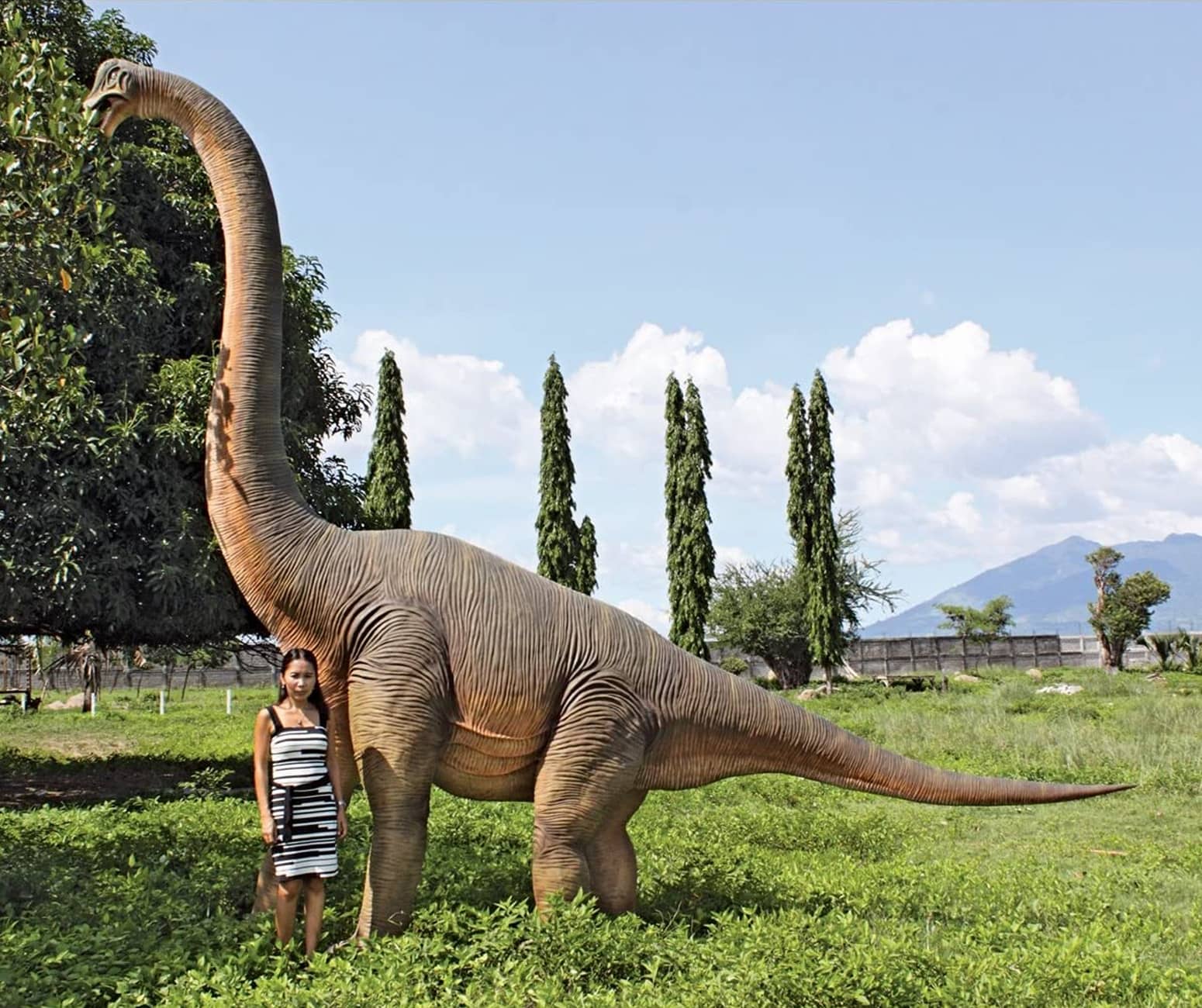
Massive Brachiosaurus Dinosaur Statue
Brachiosaurus Statue
I say again, it's possible because of the poetic language that these are "merely" a hippo and a crocodile.  The point for Job would still be the same:  God’s creatures represent the fact that His power and purposes are beyond Job's ability to contain or comprehend.  However, because we do know about dinosaurs, we also know that this very point would be so much MORE powerfully made with a Brachiosaurus and a Plesiosaur!

Am I letting that knowledge influence how I look at the text?  Perhaps.  But I think a fair reading does show that Behemoth and Leviathan transcend the size and power of any currently living animals we know (except maybe whales).  And since all the other animals referenced are real animals (the ostrich, the horse) it makes no sense that Behemoth and Leviathan aren’t also real animals – IE these can’t be mythical creatures God invents to make a point.

Without much digging (pun not intended), I can't find a lot of hard evidence that ancient men ever did find dinosaur bones.  Still. I can't believe this never happened, since in recent times, in fossil rich areas (like Montana and Alberta), the bones of very large dinosaurs were found literally staring at us without any excavation in some cases.  And no one has a better explanation for the universality of dragon myths which so closely resemble the basic look of the largest dinosaurs.  It seems at least possible that Job could have had some image of a "thunder lizard" in his head.

So I retain the somewhat whimsical (yet reasonable) notion that God may have been referring to dinosaurs in Job, even though I’ve long ago rejected the Young Earth Creation model that insists humans coexisted with them. Could God not use knowledge of extinct beasts to make the point he's making in his speech to Job?  I think it's possible, and it fits the epic descriptions better than hippos and crocodiles... unless we're talking about this bad boy:

Extinct 40 ft. Crocodile: Sarcosuchus

Saturday, July 18, 2015

What Should Christians Believe about Creation and Evolution?

QUESTION:  What should Christians believe about creation/evolution?  Did God make everything at once or could God have made the snails first knowing humans would need something to eat?  I’m not sure about the Bible’s story of creation, but I’m serious about Christ and want to know what I should believe about this.


RESPONSE: A short answer is that Christians are divided in how they think God created. Some are OK with some version of the creation story that science tells us, the idea that things changed slowly.  Some think God used that process or partially used that process of evolution to make people over many eons. Others think God did it quickly, all things at once a short while ago.
 The three main camps we break into are:

- Theistic Evolutionists.  These are Christians who believe that the theory of evolution as we learn it in school can basically be reconciled with Scripture’s account of creation.  They think Genesis is metaphor and tells us the ‘why’, but science tells us the ‘how’.  They believe God superintended the process of evolution by setting up the exact initial conditions of our universe, thus making the creation of man possible through a natural process without denying the infusion of God’s image on man at some point in the distant past.  Some well-known adherents of this view who are deeply committed Christians who take the Bible seriously are Francis Collins and CS Lewis.

- Progressive Creationists.  These are Christians who believe that the theory of evolution has many scientific problems.  They don’t have a preexisting theological issue with the idea that biological things may change over time or that the universe is very old.  They see, however, that in reconciling Scripture with the natural record, that a Designer must have been actively involved in creation infusing design and information all along the way.  Some see God creating new types (including modern man) during different creative epochs stretched over vast ages.  Intelligent Design and Day/Age theorists fall into this camp and a vast array of views fit here.  Some prominent adherents are Philip E Johnston and Hugh Ross.

- Young Earth Creationists.  These are Christians who believe that no part of the theory of evolution can be reconciled with the biblical record.  They see the anti-supernaturalist motive in play in many of evolution’s adherents since the theory explicitly rejects a “theistic” interpretation because this process is ‘unguided’ by definition.  Because of this bent, any sign of apparent conflict between the natural record and Scripture must be resolved by siding with a literal reading of the Genesis record and attempting to make the data fit it.  Thus any signs of age in the universe must be “apparent” age, since they are committed to creation happening in 7, 24-hour days some time in the recent past.  God created all life forms, all at once, in a ‘perfect’ ecosystem that had no carnivorous death until the fall.  Some notable adherents are Henry Morris and Ken Ham.

There’s a basic theological tension involved in whichever view you adopt.  In other words, there’s no ‘default’ position that Christians can take on this issue without bringing up some controversy in their faith assuming that you are deeply committed to the inspiration of all of Scripture. 

For example, the more you lean toward the textbook explanation of origins through evolution the more you have to deal with questions about the nature of Salvation.  Salvation in the Christian view is a work that God does to restore His creation design, first in fallen human hearts but finally in creation as well.  But in the evolutionary view there never was a ‘creation ideal’ – in fact, the theory says things are getting more complex and better designed and more ‘fit’ as time goes on.  

So fitting in classic Christian teachings like the special creation of people in the image of God and the catastrophic Fall of mankind into sin and how that brought curse to us and our world (and thus the need for Christ’s redeeming work) is a key issue for any who try to adopt the molecules to man view. 

On the other hand, the more you lean toward a literalistic interpretation of Genesis 1, the more closed you may be to what the data may be saying from an honest study of nature.  This is not just a challenge to intellectual honesty, it’s a challenge to the very teachings of our Scripture which tell us that God is speaking a message to us through Creation (Ps 19 and Romans 1).  

This tendency sets us up to believe in a God who is somewhat duplicitous, telling us one thing in the World and another in Word.  One simple example will suffice to outline the difficulty:  if the universe is 6000 years old, then the light coming to us from other stars and galaxies is a “show” and not reality.  God would have had to create the photons en route for them to get here in a such a short period of time.  This essentially means the heavens declare a fiction of God, and not his glory.  Some explanations are offered to resolve this particular problem, but the reliability of God and natural revelation is a key issue for any who adopt a young earth view. 

If you're wondering what is a sort of minimum that Christians really must believe about creation to be serious about their faith in Christ and take their Bible seriously, the answer is this: we believe that God speaks in two books: the book of God's Word (the Bible) and the book of Nature. Some things between those two books seem to be in conflict with each other, but if so, all true Christians believe that this means we are reading one or both of those books wrongly.  

Is this possible?  Yes!

It's possible for science to misread the book of nature which is why some scientists think nature rules out even the possibility of God's existence or intervention!  It's also possible for us to misread the book of Scripture and think that the Bible is making a scientific claim it’s not really making.  Some day, maybe we'll read both Books perfectly well and see exactly how they are both telling us the exact same true story of God's creating work... until then, there's lots of debate in the church about HOW God did it. But if God is the God of Creation and Scripture, then both books must be consistent somehow.

Some note that the Genesis story seen one way fits almost every creation model:
  • The universe is not eternal, but finite with a Cause outside itself
  • Creation began in an explosion of light.
  • Creation unfolded, not all at once, but over time.
  • The youngest species, appearing last, is mankind who is made, not out of nothing, but from the existing material of earth out of which he sprang.
It’s really something to marvel at; that these 4 tenets, first taught in Genesis, are something that even rigid naturalists can agree with!  I've also heard some very compelling harmonizations between the Genesis account and the timelines offered by modern cosmology. See one here.

Now, aside from these basic facts, there is much disagreement among Christians about how God did it.  I myself used by a Young Earth Creationist, but I’ve changed my camp and would now consider myself some sort of progressive creationist.  But what all serious Christians agree on is that God is our Creator and that God made people special, to be stewards of creation and that He made us in His image.  We further believe that we fell out of right relationship with God in the distant past through sin and this brought us and our world under a curse – this is what we all believe about the ‘whys’ of Creation. 

Because this is such a rich and potent bit of agreement, we ought to clearly separate in our minds, the “how” and the “why” questions of Scripture.  The Bible claims to be true in all the matters it touches on, but it does not claim to give exhaustive truth on matters of God’s methods.  Yet on matters of God’s meaning in creation, and in the New Creation in Christ, the Bible is explicit.  So when debating the “how”, we do well to listen to a great scientist who also happened to be a devoted follower of Jesus Christ and who had some experience wrestling with the tension of faith and science and what the Bible teaches: 


Galileo (1632): "From these things it follows as a necessary consequence that: since the Holy Ghost did not intend to teach us whether heaven moves or stands still: whether its shape is spherical or like a discus or extended in a plane: nor whether the earth is located at its center or off to one side, then so much the less was it intended to settle for us any other conclusion of the same kind. And the motion or rest of the earth and the sun is so closely linked with the things just named, that without a determination of the one, neither side can be taken in the other matters. Now if the Holy Spirit has purposely neglected to teach us propositions of this sort as irrelevant to the highest goal (that is, to our salvation), how can anyone affirm that it is obligatory to take sides on them, and that one belief is required by faith, while the other side is erroneous? Can an opinion be heretical and yet have no concern with the salvation of souls? Can the Holy Ghost be asserted not to have intended teaching us something that does concern our salvation? I would say here something that was heard from an ecclesiastic of the most eminent degree: ‘That the intention of the Holy Ghost is to teach us how one goes to heaven, not how heaven goes."